

URUGUAY
NATURAL CAPITAL INVESTMENTS IN
Uruguay has emerged as a premier forestry investment destination, offering investment-grade sovereign stability, exceptional eucalyptus productivity, strong industrial demand, and proven institutional liquidity.
Uruguay: making the case for commercial forestry
Why Uruguay
Independent research and market insights to support informed natural capital investment decisions. Uruguay pairs the political, economic and social stability of an investment-grade democracy with a forestry sector engineered for foreign capital. Since the Forestry Law of 1987, planted area has grown sevenfold to 1.16 million hectares and the sector has become one of the most dynamic drivers of the economy.
– Open capital regime: equal treatment for foreign and domestic investors, no restrictions on the purchase, sale or transfer of foreign currency, and free repatriation of capital, profits and dividends.
– Pro-investment legal stack: Forestry Law (15,939), Investment Promotion Law (16,906), Free Trade Zones Law (15,921) and Industrial Parks Law deliver tax exemptions and favourable customs regimes.
– World-class biological yields: fast-growth eucalyptus on 10–12 year rotations—among the shortest globally—with productive conditions comparable to Chile, New Zealand, Australia and South Africa.
– Sustainability built-in: 90% of plantations carry FSC and/or PEFC certification, a grid that is largely renewable, and an established forestry carbon-credit market (Verra).
– Gateway logistics: deep-water ports (Montevideo, Nueva Palmira), the new Ferrocarril Central railway, and free-trade-zone export channels into China, the EU, the US and India.
Forestry is now systemically important to Uruguay’s economy and exhibits unusually strong economic linkages. Cellulose pulp overtook beef in 2024 to become the country’s #1 export product. The CERES Institute estimates the sector’s total economic contribution (direct plus indirect) exceeds US$5 billion, with solid wood carrying one of the highest output multipliers in the economy (1.27 vs. a 0.60 national average).
– Long-lived, inflation-resilient asset: ~55% of a 20-year rotation’s cost is incurred at “year zero” (land + planting), front-loading entry value and supporting a buy-and-hold thesis.
– Deep institutional comfort: 4,000+ companies and 18,000+ direct jobs, vertically integrated majors, and credible certification and carbon frameworks already in place.
Uruguay holds investment-grade ratings from every major agency, with stable outlooks across the board—a rarity in Latin America and a key de-risking factor for long-duration timberland capital.
Investment attractiveness
Forest sector
Uruguay has established itself as one of the most attractive forestry investment destinations globally, combining political stability, strong property rights, and exceptional growing conditions. With over 1 million hectares of commercial eucalyptus and pine plantations, three world-class pulp mills backed by UPM, Stora Enso and Arauco, and continued institutional capital inflows, the country offers a compelling platform for long-term natural capital investment.
The sector benefits from a mature and export-oriented value chain, supported by investment-grade sovereign ratings, unrestricted capital flows, modern logistics infrastructure, and access to global markets. Strong biological growth, short rotation cycles, and established industrial demand provide investors with exposure to a scalable real asset class that combines income generation, capital appreciation potential, and strong ESG credentials. As a result, Uruguay continues to attract pension funds, insurance companies, family offices, and specialist timberland investors seeking long-term, risk-adjusted returns from sustainable forestry assets.
Uruguay has attracted capital from leading global investors including:
– BTG Pactual TIG — Latin American strategy: US$1.24B raised (targeting US$1.5B over 5 years across Uruguay, Chile and Brazil). Aug-2025 launch of “Plateau” with Klabin and BCI—~100,000 ha of mature timberland.
– Oji Holdings (Japan): acquired pine/eucalyptus plantations in Tacuarembó and Rivera for US$288M (May 2024), from assets formerly managed by The Rohatyn Group.
– Nuveen Natural Capital / Montes del Plata: ~32,000 ha of eucalyptus and pine plantations transacted (filed Oct-2023).
– Harvard Management Company: exited Uruguayan timber in a ~US$330M deal—evidence of liquidity and institutional exit pathways.
– IFC + ILX: US$40M committed to forestry—European pension-backed, ESG-aligned capital validating Uruguay’s legal security.
Recent forestry/natural capital deals
Pulp mill players
Uruguay has attracted capital from leading global investors including:
Combined capacity positions Uruguay as the world’s second-largest exporter of bleached eucalyptus (short-fibre) pulp, behind only Brazil. Japan’s Oji Holdings is the newest strategic entrant via a 2024 plantation acquisition.


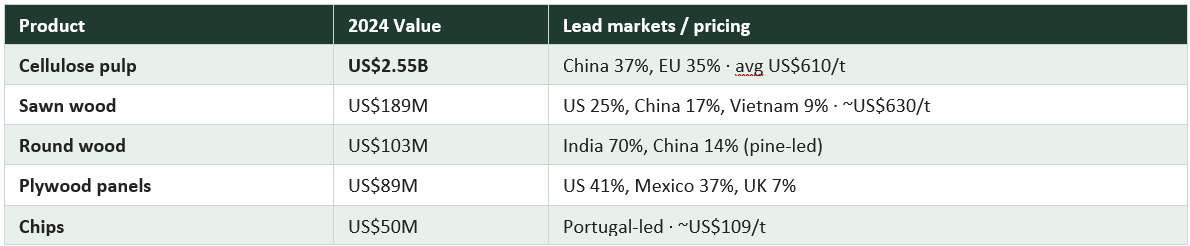
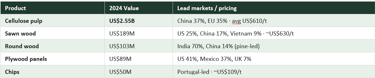
Forestry exports reached US$3.0 billion in 2024 (+27% YoY). Cellulose alone was US$2.55B (85% of sector value); the balance is a diversifying mix of solid-wood products. China (37%) and the EU (35%) are the largest pulp destinations; wood-product exports are spread across the US, EU, India and China.
Wood products exports to global markets
Explore investment opportunities

Nature & Capital is the investment advisory arm of Nature & Group
Important information
Nature & Capital works with selected specialist investment managers across forestry, natural capital and related real-asset strategies. Any information concerning specific funds, investment vehicles or opportunities is provided for general informational purposes only and does not constitute an offer, solicitation, recommendation or invitation to invest, nor investment, legal, tax or other professional advice. Information on specific investment opportunities may be made available only to eligible professional, institutional, accredited or otherwise qualified investors, as applicable, and subject to the relevant securities laws, regulatory requirements and jurisdictional restrictions. No investment opportunity is offered or made available in any jurisdiction where such offer, solicitation or distribution would be unlawful or would require Nature & Capital or any relevant investment manager to obtain a licence, registration or authorisation that has not been obtained. Prospective investors should conduct their own independent assessment and obtain appropriate professional advice before making any investment decision. Past performance, target returns and forward-looking statements, where referenced, are not guarantees of future results.